
TL;DR: Pick hockey stick flex by body weight — a working rule is Target Flex ≈ body weight in kg × 0.9–1.1, so a 65 kg player wants ~58–72 flex (≈65). Most adult Indian players need 55–75 flex, juniors need 30–50, because widely sold 85–100 flex sticks are too stiff for Indian body types. Ice players can go 5–10 flex lower than inline/rink players of the same weight.
[IMAGE: Hockey stick flex chart by age, height and weight]
What is hockey stick flex?
Flex is the number that shows how stiff or bendy a stick is — measured in pounds of force needed to bend it one inch at the centre. A lower number bends easily; a higher number is stiffer.
- Low flex (30–55): Lighter or younger players.
- Mid flex (60–75): Sweet spot for most adult recreational players.
- High flex (85–110+): Strong, experienced players with lots of shot power.
⚠️ Warn: Cutting a stick stiffens it — every 2.5 cm (1 inch) off the top adds about 3–5 flex points. Cutting 5 cm off a 75 flex makes it feel like 80–85.
Flex vs kick point
Flex is how much the stick bends; kick point is where:
- Low kick point: Bends near the blade — fast snap/wrist shots (most forwards).
- Mid kick point: Bends in the middle — all-round play.
- High kick point: Bends near the top — slap shots and long wind-ups.
Why does flex matter for Indian players?
Because most sticks sold in India are flexed for North American/European players who weigh 20–30 kg more, leaving Indian players with sticks that are too stiff.
The average adult male player in India weighs 55–75 kg vs 80–100 kg in North American leagues, so the common 85–100 flex sticks are usually too stiff. A too-stiff stick can't load properly — you push the puck instead of snapping it, and juniors/women (40–60 kg) can build bad habits that take years to fix.
By surface:
- Inline: More stationary shots; a slightly stiffer feel works.
- Rink (ball hockey): Same flex rules; rink-specific sticks have different geometry.
- Ice: Skating momentum adds power, so go 5–10 flex points lower than inline players of the same weight.
What's the stick flex chart for India 2026?
Use Target Flex ≈ body weight in kg × 0.9–1.1 as your starting point, then adjust for style and skill.
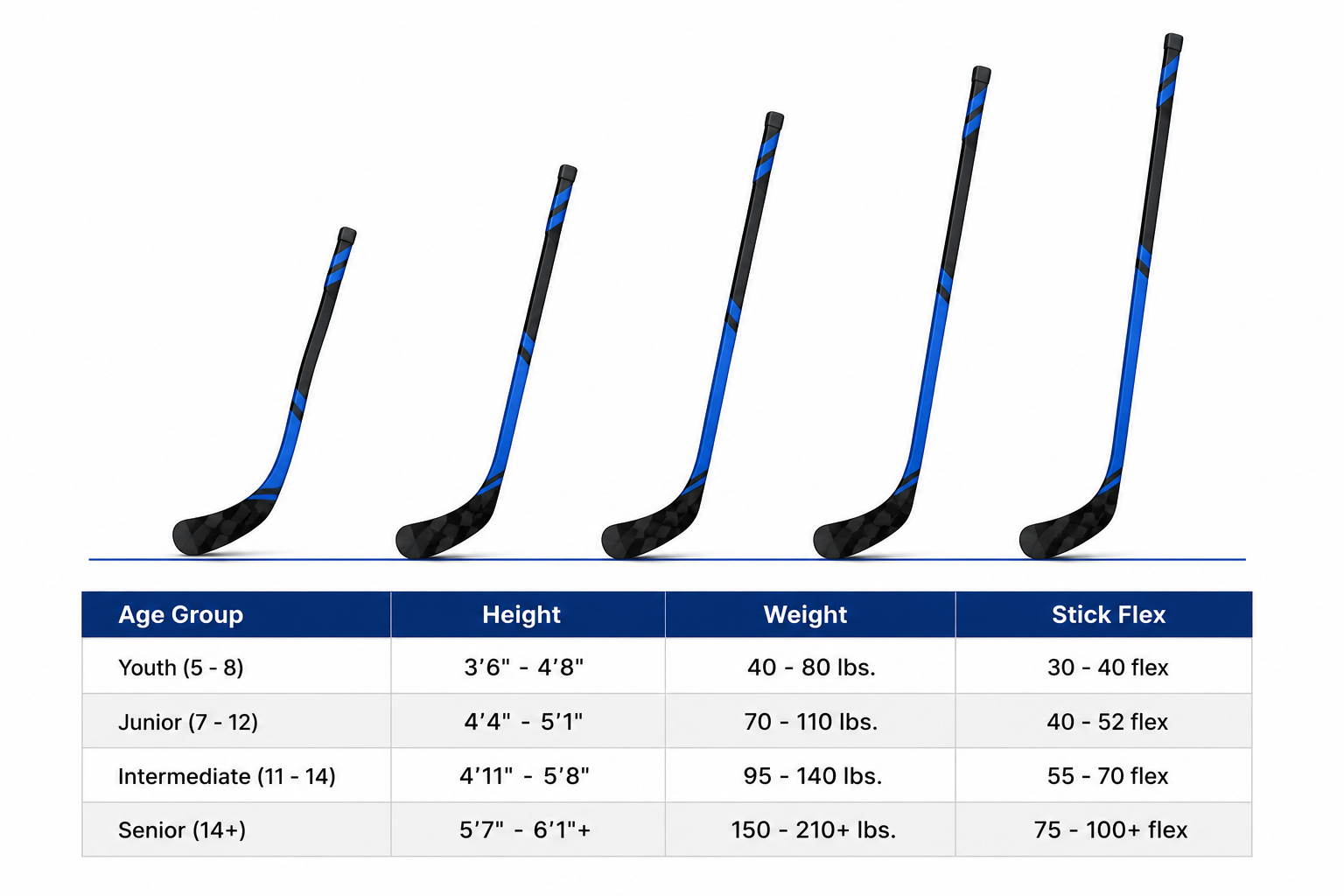
💡 Tip: Planning to cut the stick? Buy lower. A 65 kg player who'll cut 5 cm should buy 55–60 flex, not 65. Women: there's no separate "women's flex" — those favouring wrist/snap shots can go 5 points lower.
How do you choose the right flex for your game?
Start with the weight formula, then adjust for these four factors:
- Shot type: Wrist/snap shooters go lower (faster release); slap shooters can go 5–10 higher; passers/defenders can go stiffer.
- Skill level: Beginners go lower — a whippier stick teaches loading and is forgiving. Experienced players use the formula or slightly higher.
- Grip & length: High grip = longer lever, handle stiffer flex; choking down = use softer flex.
- Surface & temperature: Ice players go 5–10 lower; cold rinks (Delhi, Ladakh) make sticks feel stiffer than rated.
What flex suits forwards, defenders and goalies?
Your position changes the ideal flex:
- Forwards: Prioritise fast release — use the low end or 5 points below your number (a 70 kg forward calculating 65 may prefer 60).
- Defenders: Take more slap shots and poke checks — use your number or slightly above (a 75 kg defender: 70–80).
- Goalies: Goalie sticks are rated 14–27 flex; with a standard stick, a 60–75 flex clears and passes fine.
- Rink rover/utility: Mid-range, about 5 points below your number.
What are the most common flex mistakes Indian players make?
The biggest mistake is buying whatever stick is available without checking the flex number. Coaches across Bengaluru, Delhi, Pune and Mumbai see these repeatedly:
- Buying the cheapest/most available imported stick (often 85+ flex, far too stiff).
- Ignoring stick cutting, ending up 10–20 points stiffer than intended.
- Copying a pro's setup — a 90 kg pro's 95 flex doesn't suit a 60 kg recreational player.
- Using one stick across surfaces — fine for inline/rink, but ice needs different flex.
- Ignoring aging — composite sticks lose flex properties after heavy use or impact.
- Too stiff: wrist shot feels like a push, long wind-ups needed, hands tire fast, late release.
- Too flexible: inconsistent shots, shaft wobble on hard passes, poor slap-shot accuracy, unstable on poke checks.
Where can you buy the right flex stick in India?
Buy online or from rink pro shops and filter by the specific flex number — not just "senior" or "intermediate."
- Online (T3 Sports, Amazon India, hockey stores): Basic composite from ₹3,500; mid-range (Sher-Wood, Warrior, Alkali) ₹6,000–₹12,000; top-tier (Bauer, CCM, True) ₹18,000–₹25,000. Search 55–75 flex (adults), 30–50 (juniors).
- Rink pro shops in Bengaluru, Mumbai, Delhi, Pune give real-world local advice.
- Group import orders through clubs unlock more low-flex options.
How does Bengaluru's climate affect stick flex?
Heat softens composite sticks — above 30°C (Bengaluru, March–June), a stick can feel 1–5 flex points softer than its rating, so a 75 flex may play like 70.
- Inline/rink players in Bengaluru can size up ~5 flex points vs standard charts.
- Juniors on sub-50 flex sticks should check for shaft wobble in summer.
- Storage: Never leave sticks in a hot car or direct sun — it permanently weakens the shaft.
⚠️ Warn: In high humidity, check for stress fractures near the blade throat every 15–20 hours of play — heat and moisture speed up micro-cracking.
Where to buy the right hockey stick in India
Browse flex-rated sticks and blades at T3 Sports India:
- Hockey sticks — inline, ice and goalie, by flex
- Replacement blades & shafts
- Bauer X-Series hockey stick
- Skates and protective gear to complete your kit
Frequently Asked Questions
What flex hockey stick do I need for my weight?
Use Target Flex ≈ body weight (kg) × 0.9–1.1. A 65 kg player wants about 58–72 flex (≈65).
Why are most sticks sold in India too stiff?
They're flexed for North American/European players who weigh 20–30 kg more than the average 55–75 kg Indian player.
Does cutting a stick change its flex?
Yes — every 2.5 cm cut from the top adds about 3–5 flex points, so buy lower if you'll cut.
What flex should juniors use?
30–50 flex. Low-flex sticks build proper shooting form; adult-flex sticks create bad habits.
Should ice and inline players use the same flex?
No — ice players can go 5–10 flex points lower because skating momentum adds shooting power.
How much does a good hockey stick cost in India in 2026?
From ₹3,500 (basic composite) to ₹6,000–₹12,000 (mid-range) and ₹18,000–₹25,000 (top-tier pro models).